Mastering OpenRouter: How to Program Arbitrage and Zero-Downtime Fallbacks into Your LLM Routing Strategy
Stop hardcoding provider endpoints. Learn OpenRouter model array routing for real-time LLM price arbitrage and cascading fallback matrices. Cut token costs by 40% with zero code changes.
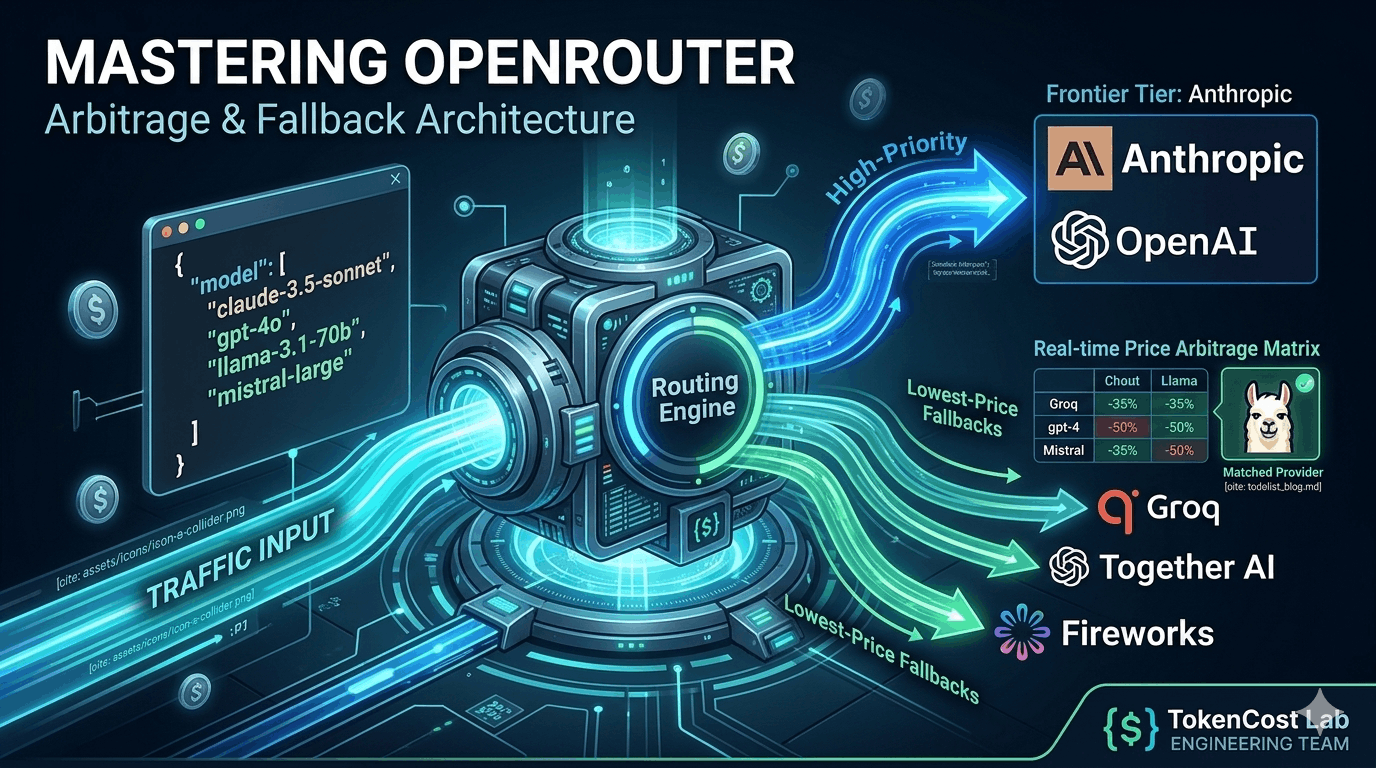
In the early days of AI engineering, choosing an LLM was a binary decision: you either hooked up OpenAI or wrapped Anthropic. But in today’s mature multi-provider ecosystem, relying on a single upstream API endpoint isn’t just an architectural single point of failure—it’s a financial liability.
OpenRouter has emerged as the definitive aggregator for frontier and open-source models. Yet, most developers use it merely as a basic API proxy, completely missing out on its most powerful features: real-time price arbitrage and cascading failover matrices.
If your backend code still hardcodes a single model string from a single hosting provider, you are missing out on significant cost savings. Here is how to configure advanced routing strategies on OpenRouter to achieve the optimal price-to-performance ratio for your production workloads.
The Paradigm Shift: Provider vs. Model Weights
When you run open-weights models (like Llama 3.3 70B, Mistral Large, or DeepSeek V3), you are no longer bound to one company’s servers. The exact same neural network weights are hosted simultaneously by dozens of competing inference providers—including Groq, Together AI, DeepInfra, Lepton, and Fireworks.
Each provider runs a different infrastructure stack, leading to a constant battle on two fronts:
- Price: Providers slash per-million token rates dynamically to capture market share.
- Availability: Token-per-minute (TPM) limits and sudden rate-limit collapses (HTTP 429) can instantly take down a specific provider’s cluster.
OpenRouter allows you to decouple the model you want from the provider hosting it, giving you programmatic control over price and resilience.
Strategy 1: The Arbitrage Machine (Lowest-Price Routing)
Instead of hardcoding a specific provider path like together/meta-llama-3.1-70b-instruct, OpenRouter allows you to query a model family using their Auto-Routing or Ordered Array parameters.
When you want to guarantee you are paying the absolute lowest market rate at any given millisecond, you can pass an array of acceptable provider endpoints for the exact same model weights. OpenRouter will automatically evaluate the routing tree from top to bottom based on live market pricing.
The Production Payload: Lowest-Price Routing
Here is how to structure a production-grade API call in Node.js/TypeScript that forces OpenRouter to hunt down the cheapest throughput for a Llama 3.3 70B workload:
import OpenAI from 'openai';

const openrouter = new OpenAI({
  apiKey: process.env.OPENROUTER_API_KEY,
  baseURL: 'https://openrouter.ai/api/v1',
});

async function routeCheapestInference() {
  const response = await openrouter.chat.completions.create({
    // 🎯 PASS AN ARRAY: OpenRouter evaluates from left to right
    // Put your preferred lowest-cost providers first
    model: [
      "deepinfra/meta-llama/llama-3.3-70b-instruct",
      "together/meta-llama-3.3-70b-instruct",
      "lepton/llama-3.3-70b-instruct",
      "meta-llama/llama-3.3-70b-instruct" // OpenRouter's auto-fallback slug
    ] as any,
    messages: [
      { role: "user", content: "Execute high-volume structural data extraction." }
    ],
    plugins: {
      // Enforce strict routing parameters
      routing: "fallback"
    }
  });

  console.log(`Matched Provider: ${response.model}`);
}
The Cost Breakdown: Real-Time Arbitrage Savings
| Provider Endpoint | Input Cost (per M) | Output Cost (per M) | Cost Factor |
|---|---|---|---|
| Provider A (Groq - High Speed) | $0.59 | $0.79 | Baseline |
| Provider B (DeepInfra - Discounted) | $0.35 | $0.40 | ~40% Savings |
| Provider C (Together AI - Standard) | $0.45 | $0.45 | Variable |
By letting OpenRouter shift traffic to whichever provider has excess capacity and lower spot pricing, you can systematically trim 30% to 50% off your open-source token expenditure without changing a single line of your prompting logic.
Strategy 2: The Unbreakable Pipeline (Cascading Fallback Matrix)
Price optimization is irrelevant if your application throws an uncaught exception to your user. If a provider suffers an outage, encounters network jitter, or hits your tier’s rate limit, your application needs an immediate recovery path.
OpenRouter’s model array parameter acts as a failover sequence. If the first item in the array returns an error code (such as 429 Rate Limited, 500 Internal Server Error, or 503 Service Unavailable), OpenRouter will intercept the failure within milliseconds and seamlessly re-route the exact same prompt context to the next model in your sequence.
Cross-Model Degradation Architecture
A truly robust AI architecture doesn’t just fall back to the same model on a different server; it degrades gracefully to cheaper, faster models if the premium model is unavailable.
Look at this multi-tier resilience strategy:
{
  "model": [
    "anthropic/claude-3.5-sonnet",
    "openai/gpt-4o",
    "anthropic/claude-3.5-haiku",
    "meta-llama/llama-3.3-70b-instruct"
  ]
}- Tier 1 (Primary):
claude-3.5-sonnetparses the complex operational logic. - Tier 2 (Frontier Backup): If Anthropic’s endpoints drop, the system instantly switches to OpenAI’s
gpt-4oto maintain maximum reasoning accuracy. - Tier 3 (Graceful Degradation): If both frontier networks experience a global cloud outage, the system automatically routes to
claude-3.5-haikuor an open-source Llama instance to keep core functionalities running at a fraction of the cost.
Engineering TokenCost Lab: Auditing Your Routing Efficiency
When building the architecture for TokenCost Lab, we realized that developers frequently fail to track their true fallback expenses. They look at a model’s base price on paper, but completely ignore the hidden overhead generated when an app falls back to a more expensive tier during high-traffic periods.
To eliminate this blind spot, our real-time simulator in the ModelSwitcher tracks Weighted Average Routing Costs (WARC) using a probabilistic token cost formula:
$$\text{WARC} = \sum_{i=1}^{n} (P_i \times C_i)$$
Where:
- $P_i$ is the probability/frequency of hitting routing tier $i$ (based on historical provider uptime and rate limits).
- $C_i$ is the composite token cost of that specific provider tier.
If your primary tier has a 95% success rate and costs $1.00/M tokens, but your backup tier costs $5.00/M tokens and absorbs the remaining 5% of traffic due to rate limits, your true operating cost isn’t $1.00—it’s $1.20/M tokens.
Want to test your own routing configuration? Use the TokenCost Lab Sandbox to simulate provider failover scenarios and calculate your real WARC before deploying to production.
Action Plan for AI Architects
- Audit Your Endpoints: Locate every file in your codebase importing an LLM client. If you see hardcoded provider-specific strings for open models, wrap them in an openrouter-compliant array.
- Inject Resilience into Cron Workers: For asynchronous processing or high-volume indexing, configure a fallback array that starts at ultra-low-cost providers and cascades upward only when hitting capacity caps.
- Benchmark with TokenCost Lab: Before deploying a complex fallback matrix to production, use the TokenCost Lab Router Optimization Sandbox to plug in your expected throughput. Visually map out your pricing floors, run edge-case downtime simulations, and discover the exact configuration required to protect both your application’s runtime and its margins.
Published by the TokenCost Lab Engineering Team. Auditing compute, protecting margins.