SiliconFlow vs. OpenRouter: The Ultimate 2026 Compute Showdown for AI Architects
Compare SiliconFlow vs OpenRouter for LLM inference: latency benchmarks, pricing traps, and architectural tradeoffs. Find out which AI inference provider delivers the best ROI for your production stack.
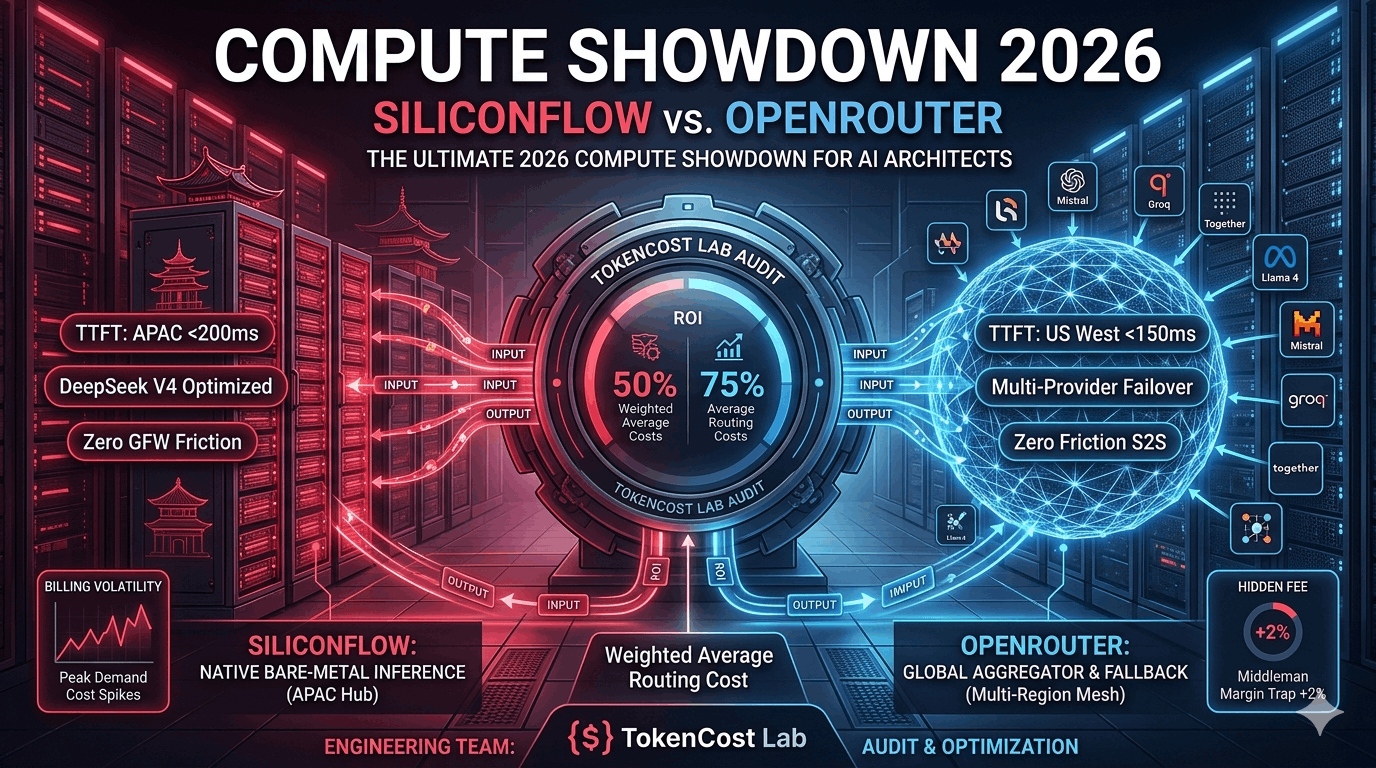
SiliconFlow vs. OpenRouter: The Ultimate 2026 Compute Showdown for AI Architects
TL;DR: SiliconFlow delivers sub-300ms latency inside China via bare-metal clusters and proprietary inference kernels. OpenRouter wins globally with edge-accelerated multi-provider routing and 100+ model catalog. Use SiliconFlow for APAC-localized workloads and DeepSeek pipelines. Use OpenRouter for multi-model heterogeneous stacks and global redundancy. The optimal architecture uses both in an asymmetric hybrid routing layer — route heavy APAC traffic to SiliconFlow with OpenRouter as a fallback grid. Model your exact cost floors in the TokenCost Lab Compare Engine.
The year is 2026, and raw LLM intelligence has officially become a commoditized utility. With open-weights models like DeepSeek V3/V4 and the Llama 4 ecosystem matching or exceeding proprietary models, the battlefield has shifted from who builds the smartest model to who runs inference the fastest and cheapest.
For developers looking to scale production agents, two giants dominate the infrastructure conversation: SiliconFlow, the powerhouse of domestic Chinese bare-metal inference optimization, and OpenRouter, the undisputed global aggregator of multi-provider routing matrices.
Choosing between them isn’t just about comparing dollar values on a landing page. It’s an architectural decision that impacts network jitter, compliance, cross-border routing overhead, and billing clarity. Let’s look at the deep technical realities of SiliconFlow vs. OpenRouter to find out who earns the “Value King” crown for your specific stack.
The Core Architectural Divide
To understand their real-world performance, we must first look at the fundamental difference in how these platforms deliver tokens to your backend.
1. SiliconFlow: The Bare-Metal Optimization Engine
SiliconFlow is an Inference Service Provider (ISP) running direct bare-metal clusters. They build proprietary inference kernels (like SiliconLLM) optimized directly at the hardware layer. When you ping SiliconFlow, you are interacting directly with the servers hosting the weights.
2. OpenRouter: The Meta-Layer Aggregator
OpenRouter is a Router and Broker Layer. They rarely host models on their own metal; instead, they act as an intelligent programmatic clearinghouse that proxies your requests across an array of dozens of underlying upstream providers (which sometimes includes SiliconFlow itself, alongside Groq, Together AI, and Fireworks).
The Latency & Jitter Matrix: A Tale of Two Networks
The biggest hidden cost in AI engineering isn’t token pricing—it’s Time to First Token (TTFT) and network reliability. This is where your geographical deployment vector makes or breaks your application’s user experience.
| Metrics & Network Behavior | SiliconFlow (Domestic Nodes) | OpenRouter (Global Mesh) |
|---|---|---|
| Mainland China TTFT | 150ms – 300ms (Ultra-low, local BGP) | 800ms – 2500ms (High jitter due to cross-border TLS handshakes) |
| Global / US West TTFT | 600ms – 1200ms (Cross-border latency penalty) | 100ms – 250ms (Edge-accelerated routing) |
| Network Jitter (GFW Friction) | Zero inside the local network perimeter | High variable spikes during peak business hours |
| Rate Limit Hardiness | Incredible high-throughput concurrency limits | Subject to the weakest link in the active provider array |
The Local Network Edge
If your backend or user base is anchored within mainland China or neighboring APAC hubs, SiliconFlow is the undisputed speed champion. By serving tokens directly from localized NVLink clusters, they bypass the cross-border routing degradation and Great Firewall (GFW) deep-packet inspections that constantly inject 2+ second delays into OpenRouter connections.
Conversely, if your application runs on Vercel, AWS us-east-1, or Cloudflare Pages, OpenRouter leverages direct localized fiber connections to premium Western clusters, leaving SiliconFlow in the dust.
Pricing Realities and the “Hidden Billing Traps”
Both platforms market rock-bottom rates, but their billing engines behave in vastly different ways under production conditions.
SiliconFlow’s Direct Volatility
SiliconFlow prices tokens natively, often offering aggressive subsidies on premier open-source models to anchor developer loyalty. However, because you are dependent on a singular cluster pool, their pricing structure is highly tied to immediate local demand. During peak Asian working hours, concurrency limits can narrow drastically unless you negotiate dedicated enterprise GPU instances.
OpenRouter’s “Middleman” Margin Trap
OpenRouter claims to deliver raw provider rates, but navigating their dynamic arbitrage matrix requires vigilant configuration.
If you configure OpenRouter to use its default auto-routing logic, the system prioritizes availability and throughput over absolute thrift. If a cheap provider experiences a momentary micro-outage or rate-limiting spike, OpenRouter will instantly and invisibly flip your request to a higher-priced premium provider tier.
Without setting hard constraints, an influx of traffic could silently shift your processing to an endpoint that costs twice as much per million tokens, causing your real operating expenses to deviate wildly from your initial estimates.
Feature Matrix: Flexibility vs. Raw Muscle
+-----------------------------------------------------------------+
|                        COMPUTE ECOSYSTEM                        |
+-----------------------------------------------------------------+
|  [ SiliconFlow ]                   |  [ OpenRouter ]            |
|  - Bare-metal Kernels              |  - Multi-Provider Fallbacks|
|  - Proprietary Acceleration        |  - 100+ Model Catalog      |
|  - Rock-solid Localized Pipes      |  - Zero-friction S2S Hub   |
+-----------------------------------------------------------------+
When to Choose SiliconFlow
- Localized Workloads: Your infrastructure is deployed locally, and you require sub-second latency for complex real-time tasks.
- DeepSeek Native Optimization: You are running massive, sustained pipelines on models like DeepSeek V3/V4 and need maximum concurrent token throughput.
- Predictable Compliance: Your enterprise data pipeline requires strict localization and sovereign network compliance without international transit loops.
When to Choose OpenRouter
- Multi-Model Heterogeneous Stacks: Your app switches dynamically between proprietary models (like Claude 3.5 Sonnet) and open-source models in a single user session.
- Agile Indie Hacking: You want to test 15 different fine-tuned variants of Llama or Mistral over a weekend without setting up multiple top-up accounts or currency exchanges.
- Global Redundancy Required: You need automated failover structures where code automatically shifts targets if a hosting platform goes offline.
Frequently Asked Questions
Which is cheaper: SiliconFlow or OpenRouter?
It depends on your traffic profile and configuration discipline. SiliconFlow often offers aggressive subsidies on open-source models like DeepSeek V4, but its pricing is tied to local demand — peak Asian hours can reduce concurrency. OpenRouter’s raw provider rates can be lower, but its default auto-routing silently switches to premium tiers during outages, inflating costs by up to 2x. Use the TokenCost Lab Compare Engine to model both scenarios against your actual volume.
Is OpenRouter faster than SiliconFlow?
Geographically dependent. For users inside mainland China or APAC, SiliconFlow is faster (150–300ms TTFT) because it serves tokens from local bare-metal clusters bypassing cross-border routing. For global / US West deployments, OpenRouter is faster (100–250ms TTFT) via localized fiber connections to Western GPU clusters.
Can I use SiliconFlow and OpenRouter together?
Yes — and that is the recommended architecture. Deploy an asymmetric hybrid routing layer: route APAC-localized and DeepSeek-heavy workloads to SiliconFlow’s bare-metal pipelines, and configure OpenRouter as a global fallback grid. If SiliconFlow experiences localized congestion, traffic gracefully overflows into OpenRouter’s multi-provider mesh. Simulate your hybrid blend in the TokenCost Lab Sandbox.
Does OpenRouter route through SiliconFlow?
Yes. Open Router operates as a meta-layer aggregator proxying across dozens of upstream providers — SiliconFlow is among them, alongside Groq, Together AI, DeepInfra, and Fireworks. This means you can access SiliconFlow’s hardware through OpenRouter’s API, though you lose the direct low-latency pathway and pay OpenRouter’s routing margin.
The TokenCost Lab Verdict
To truly optimize your architecture in 2026, stop trying to pick a singular winner. The absolute highest-value play is to utilize both via an asymmetric hybrid routing layer.
By deploying a localized router instance, you can point your heavy, background text processing and local APAC requests directly to SiliconFlow’s high-efficiency pipelines. Simultaneously, pass an OpenRouter endpoint as your primary fallback string inside your code array. If SiliconFlow encounters localized congestion, your system gracefully leaks the overflow traffic into OpenRouter’s global fallback grid.
Unsure how to balance the latency tradeoffs between bare-metal clusters and proxy routers? Plug your system’s global ping profiles and volume targets into the TokenCost Lab Compare Engine to visualize your exact cost floors and discover the optimal blend for your operational margins. Run outage and failover simulations in the TokenCost Lab Sandbox before deploying to production.
Published by the TokenCost Lab Engineering Team. Auditing compute, protecting margins.