The Hidden ROI of Premium Tokens: When to Switch Your API from DeepSeek Back to Claude
DeepSeek is cheap but Claude catches logic flaws your senior dev would spend hours debugging. Learn the TCO framework and dynamic switching rubric to optimize your LLM routing strategy.
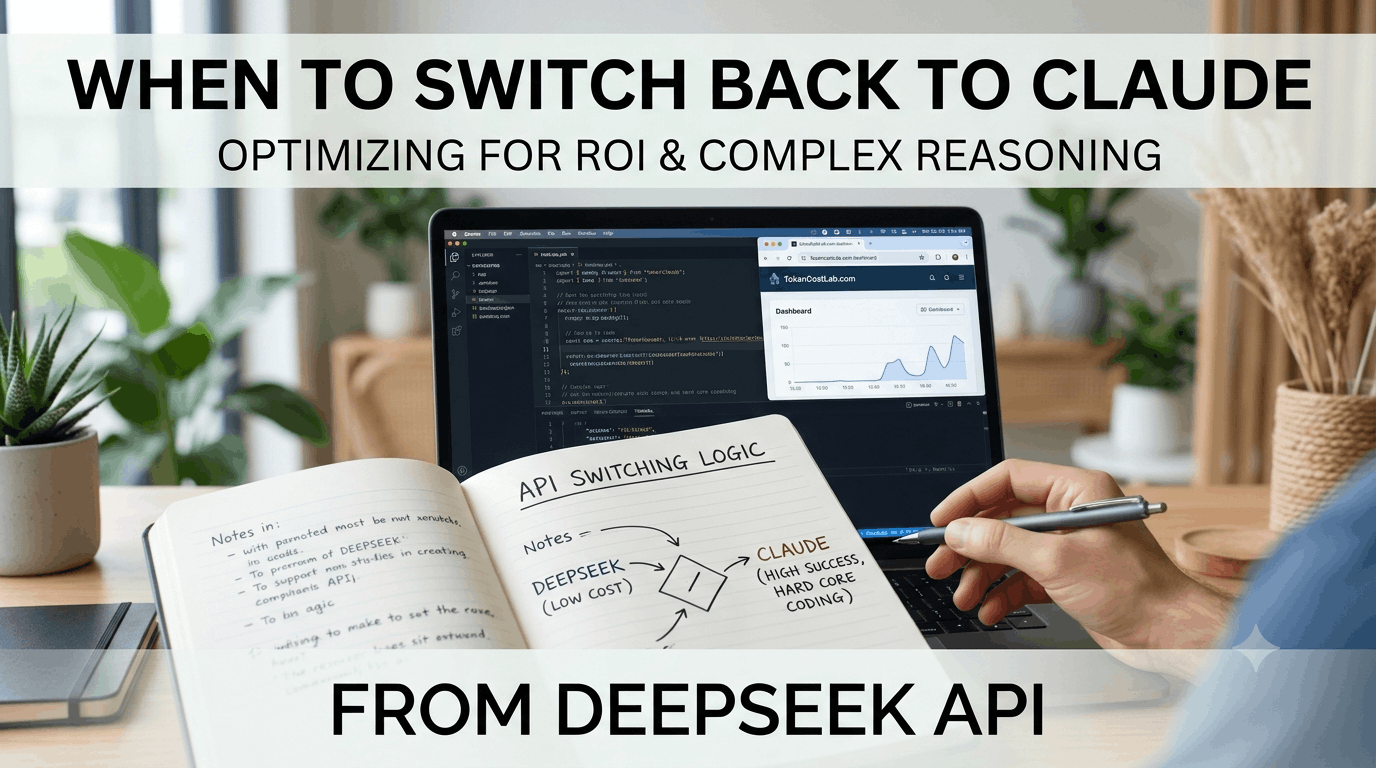
TL;DR: DeepSeek is a champion for high-tolerance, low-complexity workloads. But when developer debugging time, logic failure costs, and production pipeline brittleness are factored in, Claude’s premium tokens often deliver 90%+ lower Total Cost of Ownership. Use the Switching Point Framework below to dynamically route your traffic — and model your exact cost floors in the TokenCost Lab Compare Engine.
The open-source and low-cost AI revolution has fundamentally shifted how engineering teams budget for LLMs. With providers like DeepSeek offering near-frontier capabilities at a fraction of the cost, switching your API routing to the cheapest token provider seems like an absolute no-brainer. If you can get 90% of the performance for 95% less cost, why pay the premium?
But anyone building production-grade AI systems knows that sticker price is an illusion.
When you factor in developer friction, debugging loops, and the catastrophic costs of logic failures, “cheap” tokens can quickly become the most expensive line item on your balance sheet.
Here is a cold, hard framework for evaluating when it is absolutely worth switching your API from DeepSeek back to Claude (Anthropic), and how to calculate the true, hidden ROI of premium intelligence.
1. The Real Equation: Token Costs vs. Engineering Hours
To understand the ROI of Claude, we have to look past the API billing dashboard and calculate the Total Cost of Ownership (TCO) of an AI-generated feature.
Consider this scenario: You are refactoring a complex state management system or conducting a deep code audit.
- The DeepSeek Route: You run a prompt that costs $0.002. The output is 85% correct, but it introduces a subtle race condition. Your senior engineer spends 2 hours debugging, tweaking prompts, and running local tests to fix it.
- The Claude Route: You run the same prompt using a premium Claude model. It costs $0.06 (30x more expensive!). However, it nails the architectural edge case on the first attempt. Your engineer reviews it, approves it, and moves on in 10 minutes.
The Math:
If your senior developer costs the company $100/hr:
- DeepSeek TCO: $0.002 (Tokens) + $200 (Developer Time) = $200.002
- Claude TCO: $0.06 (Tokens) + $16.66 (Developer Time) = $16.72
In high-complexity environments, Claude didn’t cost you 30x more; it saved you 90% of your total budget.
2. Scenario Archetypes: Where Claude is Irreplaceable
Not all workloads require premium reasoning. If you are summarizing customer support tickets or extracting entities from text, DeepSeek is an absolute champion. But Claude is worth every penny in the following three high-stakes scenarios:
Archetype A: Hardcore Programming & Multi-File Architecture
When building applications through “intent-driven” coding or refactoring large codebases, context window efficiency and structural integrity matter most.
- The Claude Advantage: Claude possesses an unparalleled ability to maintain strict adherence to complex architectural constraints (e.g., maintaining clean separation of concerns between an Astro backend and React components). It minimizes “code drift” and rarely forgets the initial system prompt during long conversations.
Archetype B: High-Value Logic Auditing
If you are auditing smart contracts, financial data pipelines, or security-critical backend logic, the price of a mistake isn’t an error log — it’s a business disaster.
- The Claude Advantage: Claude’s needle-in-a-haystack recall and nuanced understanding of implicit edge cases make it far superior at catching what isn’t there. A single missed logic flaw could cost thousands of dollars; paying a premium for Claude’s reasoning is effectively ultra-cheap insurance.
Archetype C: Brittle Deterministic Output (Strict JSON/TS Compliance)
When an LLM sits in the middle of an automated production pipeline, a single malformed bracket breaks the entire workflow.
- The Claude Advantage: While open models have improved significantly at tool calling, Claude still maintains a tighter grip on complex TypeScript definitions and nested JSON structures under heavy token pressure.
3. The “Switching Point” Framework
How do you operationalize this routing logic in your application? Use this simple rubric to decide when to dynamically route traffic back to Claude:
| Metric / Dimension | Route to DeepSeek | Route to Claude |
|---|---|---|
| Failure Tolerance | High (Human-in-the-loop can easily catch errors) | Zero (Production code, security, financial logic) |
| Prompt Complexity | Single-turn, straightforward instruction | Multi-turn, multi-file dependency, highly abstract |
| Iteration Loop | One-and-done output | Iterative debugging, code generation, refactoring |
| User Experience | Asynchronous / Background processing | Real-time, user-facing generation where delay hurts |
4. Maximizing ROI: The Hybrid Routing Strategy
The goal isn’t to abandon budget-friendly models completely. The smartest engineering teams are implementing semantic routing — classifying incoming requests and dynamically dispatching them to the optimal provider.
Pro-Tip: Use a lightweight router to classify incoming user requests. If a user asks to “Write an optimization script for this SQL database,” route it to Claude. If they ask to “Generate a boilerplate button component,” route it to DeepSeek. For a deeper look at cascading fallback matrices and multi-provider arrays, see our guide on OpenRouter LLM routing strategies.
By analyzing your true token spending alongside developer velocity, you stop looking at LLMs as a commodity utility bill and start looking at them as a leverage multiplier.
Unsure how your specific workload balances against real-time pricing data? Use the TokenCost Lab Compare Engine to visualize exact cost floors across DeepSeek and Claude tiers. Run failover simulations in the TokenCost Lab Sandbox to stress-test your routing strategy before deploying to production.
Published by the TokenCost Lab Engineering Team. Auditing compute, protecting margins.